
How is your terminology database built up?
TermBoy databases are built using two different methods, which can also be combined:
- Organic build-up: if your organisation has TTN do its translating, the database grows automatically with every translation project. This build-up is included in the translation costs.
- Systematic build-up with Web-to-TM: TermBoy analyses your entire website and captures the full terminological range of your field in one go. This build-up is billed separately.
Organic build-up is the convenient way in. For visibility in chatbots, however, it is on its own unsuitable in many cases, because translation projects do not cover the full range of your field — that is what systematic build-up is for.
How does organic build-up via translation projects work?
As soon as a new order (a translation project) arrives, TermBoy gets to work:
- It extracts the terminology from the original files and creates a candidate list.
- Terms already present in your terminology database are eliminated — only new items are processed further.
- A fast AI makes a first assessment and checks whether the term is relevant to your field at all.
- Only then does a more powerful AI take over: it defines the term based on the information on your website. If it finds too little material there, it draws on related pages until the term is cleanly defined.
- TermBoy then searches for example sentences with usage examples, grammatical information and references to standards, Wikipedia and other internet sources — in all the languages of the term bank.
On the screen below, TermBoy displays the candidates, the still-missing terms and the newly entered terms in real time.
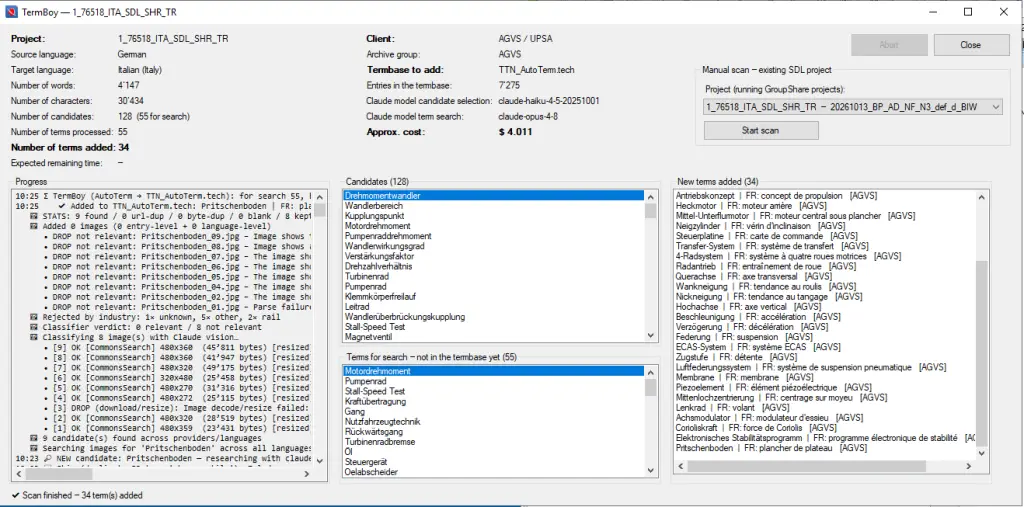
Organic build-up is included in the translation costs and billed via the line or word price.
How does systematic build-up with Web-to-TM work?
Step 1: Web-to-TM. TTN’s translation search engine — called Keybot — downloads all internet pages of an organisation or a group of organisations and organises them in a parallel database. A specialised AI breaks the texts down into individual sentences and sentence segments; another aligns them: every sentence from the internet pages and the downloaded PDF documents is stored with its corresponding translations and fed into a translation memory — called Translation Memory (TM) in the trade. A TM has a fuzzy-match index and shows the translator identical or similar sentences while they work. This considerably eases the translation work and improves quality, because the same wording is always used.
Step 2: term extraction. Once all sentences in all languages are stored in the translation memory, TermBoy begins its work. It extracts the terms, checks whether they are relevant to your field, and creates a candidate list. It gathers the already-existing translations directly from the translation memory. Your terminology thus remains a continuum: no terms enter the database that were previously translated differently.
Step 3: definition and documentation. Now comes the most computationally intensive work. For each term, TermBoy first searches the client’s internet pages, gathers a maximum of information and defines the term on this basis. It looks for a typical example sentence that explains the term, and records synonyms and spelling variants. It then documents the term via Wikipedia and numerous specialist pages — with different emphases depending on the field:
- Technology: standards are central. A term used in an ISO standard must be entered in the database exactly as it appears there.
- Science: for animals and plants the Latin name is added.
- Law: statutory articles and rulings are referenced so that the term can be placed in its legal context.
- Medicine and pharma: the relevant specialist nomenclatures are taken into account, such as the international nonproprietary names for active substances.
Individual customisation. TermBoy offers various base models that are customised individually for each client. The search algorithm too is set up per client: so-called priority domains are defined — internet sources in the immediate vicinity of your domain that are given preference during the search. If, for example, a database is built for an insurer in Switzerland, the system must not access internet pages in Germany or France — an entirely different legal context applies there.
Costs. Systematic build-up is chargeable and is normally billed per entry. Depending on the case, the costs for downloading the pages and building the translation memory are added — that is, the parallel database with the text blocks that forms the basis for the terminology database. These costs depend on the size and structure of the website.
What information does an entry contain?
A complete entry comprises the term in all languages, a definition, a usage example, synonyms, references and further information. Depending on the field, grammatical details (gender, part of speech), language register and geographical usage, scientific names, formula symbols and SI units are added — and, where helpful, images.
How are images integrated?
Technical terms in particular can be presented far more clearly with images, diagrams and drawings. TermBoy stores two kinds of images: images that can be used for all languages, and images with captions that apply to one language only.
Which languages does TermBoy support?
TermBoy works with up to 250 languages and 20 different writing systems. Each term is given its own page per language; the language versions are linked to one another so that search engines serve the correct language version.
Are the entries created by the AI checked?
Yes — and in a graded manner according to reliability. The system calculates a reliability code between 0 and 100 for each term. If a term comes from an ISO standard, from Wikipedia or from a federal administration page, it is rated higher and does not necessarily have to be checked. Entries that fall below a defined reliability level first receive the status “proposed”. Your specialists and TTN’s terminologists and translators can check, correct and validate every entry; the validation status is visible in the entry at all times. This keeps it transparent which is an AI suggestion and which is verified terminology.
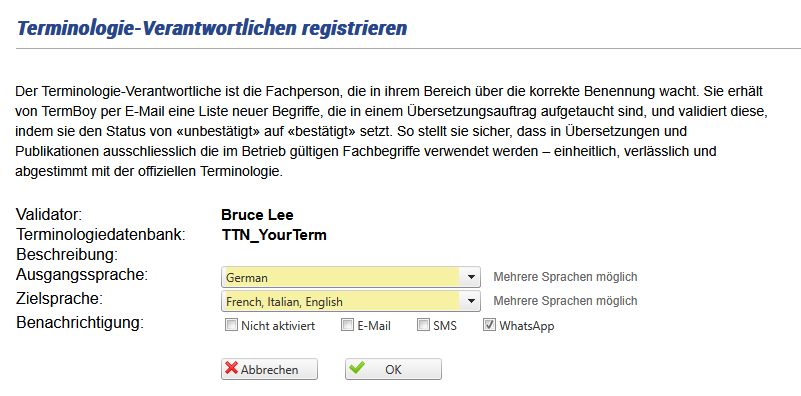
On request, we register your specialists as terminology officers. The terminology officer is the specialist who watches over correct naming in their area: they receive from TermBoy, by email, SMS or WhatsApp, a list of the new terms that have appeared in a translation project, and validate them by changing their status from “unconfirmed” to “confirmed”. This ensures that translations and publications use exclusively the specialist terms valid within the organisation — consistent, reliable and aligned with the official terminology.
What is the difference between public and internal terms?
When building the database, the algorithm distinguishes between internal and public terms. Internal terms (for example job titles or company-internal expressions) are available only to the translators, require no definition and never appear online. Public terms define your organisation’s field of activity: they are published in the web glossary and referenced in the sitemap so that search engines and chatbots can pick them up.